The Cubicle Climate Problem: Why Your Office Air Is Drinking Your Water for You
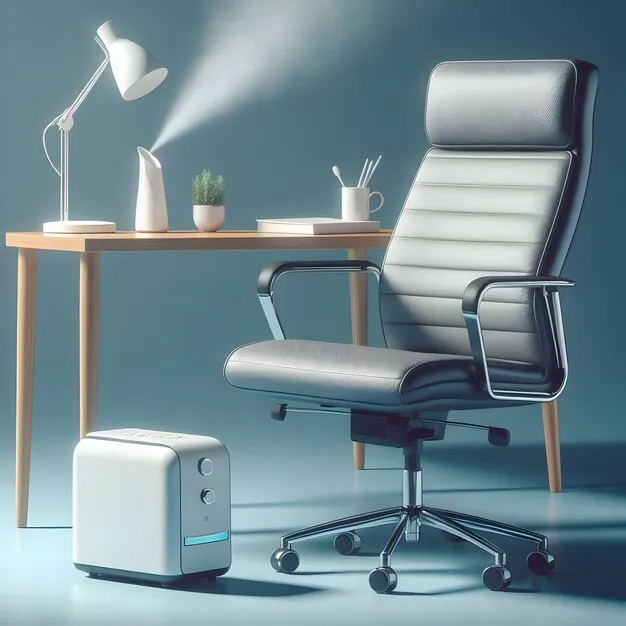
Photo: dry office cubicle desk humidifier water bottle workplace, via img.freepik.com
You've been at your desk since 8:30. You had a coffee, a decent lunch, and a bottle of water sitting somewhere near your keyboard. And yet by mid-afternoon, your throat feels scratchy, your eyes are gritty, and your brain feels like it's buffering.
Your first guess is probably the same as everyone's: too many carbs at lunch, not enough sleep, or the dreaded blood sugar crash. But there's another suspect hiding in plain sight — or rather, blowing in plain sight. The air in your office.
The Air You Breathe Is a Water Thief
Most American office buildings run on HVAC systems designed around one goal: keep the temperature comfortable. Humidity? That's usually an afterthought. In fact, in the winter especially, many commercial buildings push air with relative humidity in the 20 to 30 percent range — sometimes lower. The desert Southwest averages 30 to 40 percent humidity outdoors. Your office can be drier than Phoenix.
"When indoor humidity drops below about 40 percent, your body loses moisture faster than most people realize," explains one building engineer we spoke with, who spent two decades designing systems for corporate campuses across the Midwest. "Every exhale releases water vapor. Your skin is constantly evaporating moisture. In dry, conditioned air, that loss speeds up — and nobody feels it the way they'd feel sweat."
That's the sneaky part. Exercise dehydration announces itself. Cubicle dehydration doesn't. You're not hot, you're not visibly sweating, but you're still losing water through respiration and transepidermal water loss — the slow, invisible seep of moisture through your skin — all day long.
The Regional Breakdown: Where Office Air Hits Hardest
Not all dry office air is created equal. A rough guide:
- Northern states in winter (Minnesota, Michigan, New England): The worst offenders. Cold air holds almost no moisture, and when heating systems warm it up, relative humidity plummets — often into the teens. Office workers in Minneapolis or Buffalo are essentially living in a low-grade desert from November through March.
- Mountain West (Denver, Salt Lake City, Boise): Already-dry outdoor air plus HVAC equals a double hit. Altitude adds faster breathing rates to the mix.
- The South and coastal areas (Atlanta, Houston, the Carolinas): AC is the issue here. Air conditioning strips moisture as it cools, so a 75-degree office in July can be drier than the muggy parking lot outside.
- The Southwest (Phoenix, Las Vegas, Tucson): Dry outdoors, dry indoors. If you work in a glass tower in downtown Phoenix, your hydration needs a strategy, not a suggestion.
What It Feels Like (And Why You Blame the Wrong Thing)
Occupational health researchers have long noted that mild dehydration — as little as one to two percent of body weight — is enough to measurably dull concentration, slow reaction time, and worsen mood. But because the losses in an office happen slowly and invisibly, most workers misattribute the symptoms.
Scratchy throat? Blamed on a cold. Tired eyes? Blamed on screen time. The 2 p.m. fog? Blamed on lunch. Meanwhile, the common thread — eight hours in dehumidified, recycled air — goes unexamined.
There's also a behavioral trap: heavily air-conditioned offices feel cool, which suppresses the thirst response. Your body's hydration alarm is volume-sensitive, and a brisk 68-degree office keeps the volume low even as your water balance quietly drifts.
Desk-Level Fixes That Actually Work
You can't re-engineer your building's HVAC system from a cubicle. But you can fight back at the personal level:
1. Put water in your line of sight, not your memory. A bottle you have to think about is a bottle you won't drink. Keep it open on the desk — you'll sip roughly twice as much as you would with a capped bottle stashed in a drawer.
2. Get a cheap hygrometer. Ten dollars online. If your desk reads under 35 percent humidity, you've confirmed the problem — and you have a great excuse for the next fix.
3. Run a small personal humidifier. Desk-sized units cost less than a month of fancy electrolyte packets and can nudge your immediate microclimate up 10 to 15 percentage points. Your skin and sinuses will notice within days.
4. Choose your breaks strategically. If your building has a humid zone — a plant-filled lobby, a kitchen, a greenhouse window — take your water breaks there. You'll absorb ambient moisture and drink more readily in a warmer space.
5. Watch the coffee math. A morning latte in dry air is a mild one-two punch: mild diuretic effect plus reduced thirst signaling. You don't need to quit coffee — just match each cup with a glass of water and stop treating the break room Keurig as your hydration station.
6. Eat your water at lunch. Soups, oranges, grapes, yogurt, salads with juicy tomatoes — the office lunch that doubles as fluid intake is a legitimate strategy, not a diet gimmick.
If You Manage the Building
Facilities managers, take note: ASHRAE guidance suggests keeping occupied spaces in roughly 40 to 60 percent relative humidity for both comfort and respiratory health. If your building hovers in the 20s all winter, you're not just drying out your workforce — you may be paying for it in afternoon productivity. Humidification retrofits aren't cheap, but neither is an office full of people who hit a wall at 2 p.m.
The Bottom Line
For the roughly 80 percent of American workers who spend their days indoors, the office environment is part of your daily water budget whether you've counted it or not. The slump you've been blaming on lunch might actually be your building's air quietly taking a cut of your hydration all day long.
Track your humidity, keep water visible, and treat that afternoon fog as a data point — not a character flaw. Your body's been telling you what it needs. It just turns out the message was partly about the thermostat.